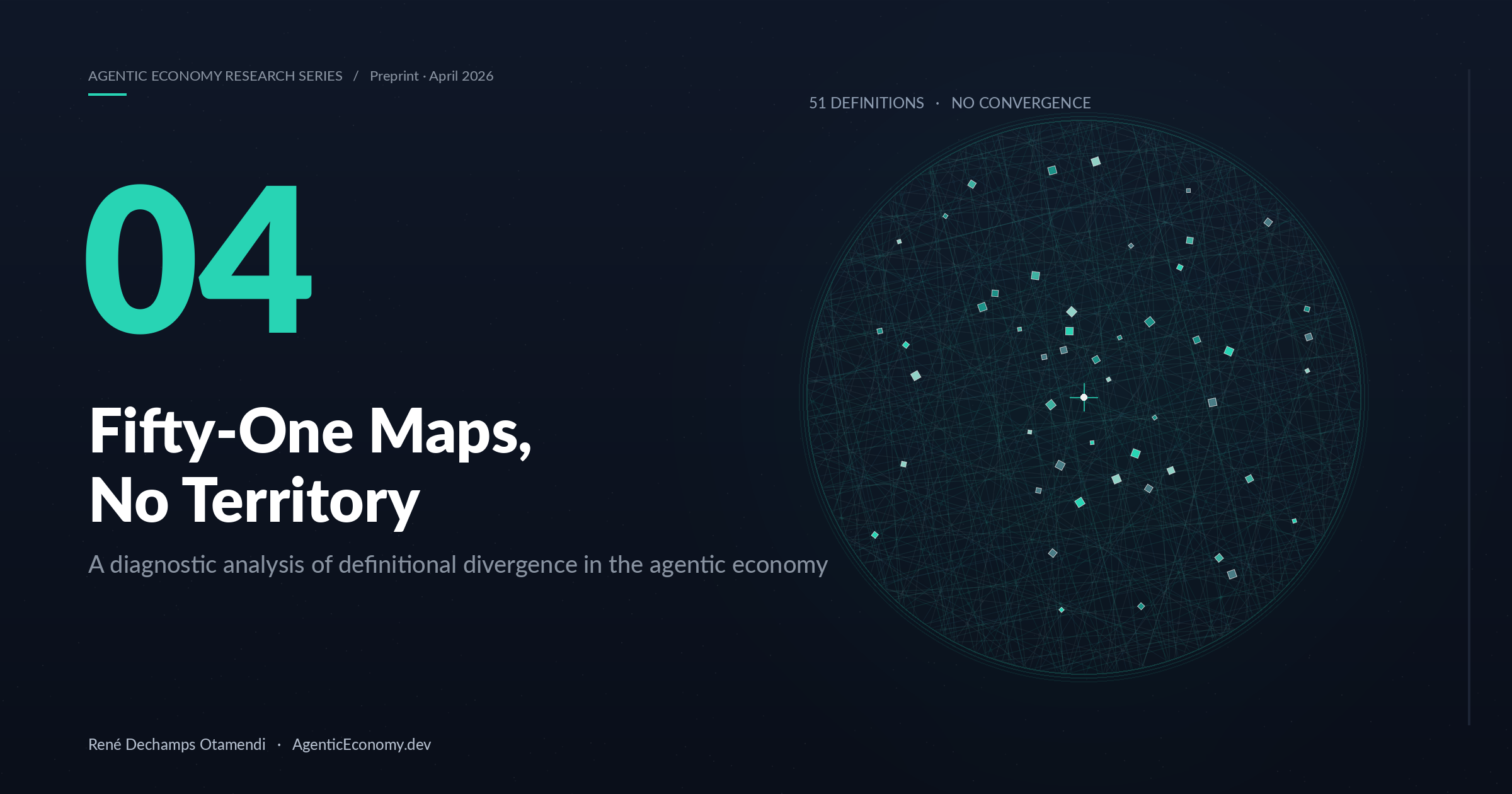
Fifty-One Maps, No Territory
A diagnostic analysis of definitional divergence in the agentic economy (2021–2026).
Abstract
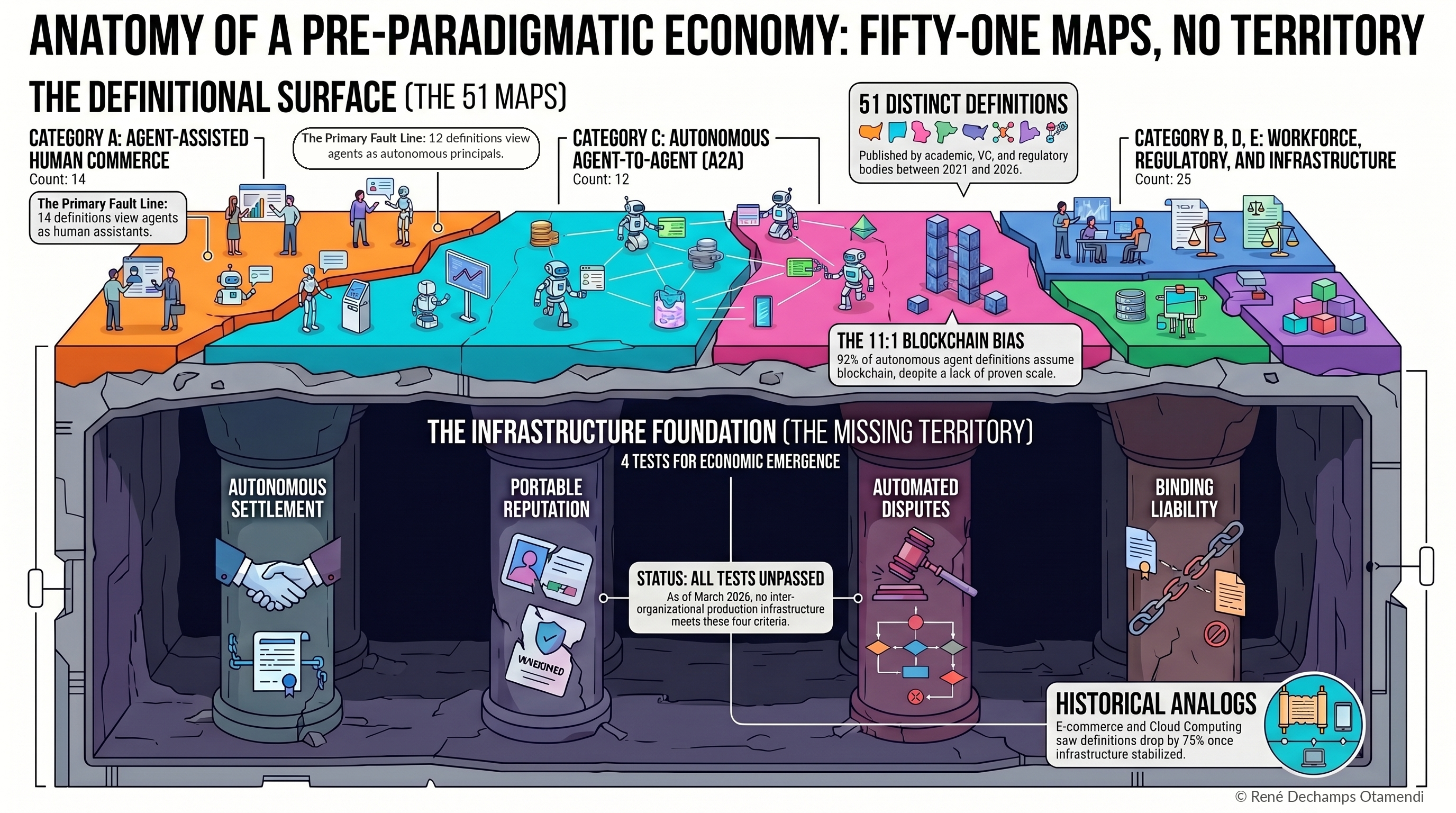
The term "agentic economy" appears in at least fifty-one distinct published definitions between January 2021 and March 2026, issued by academic researchers, venture capital firms, central banks, protocol projects, payment networks, standards bodies, and consultancy houses. This paper advances a diagnostic reading of that proliferation: when a concept is supported by functioning infrastructure, its definitions converge; when definitions multiply without convergence, the concept is a vocabulary in search of a referent.
We catalogue the full corpus, classify it into five categories and two fault lines, and situate it within the sociology of emerging technology vocabularies. Using three historical analogs — electronic commerce (1995–2000), cloud computing (2006–2011), and the sharing economy (2010–2015) — we show that definitional stabilization tracks infrastructure maturity, not research activity. We then propose four empirical tests whose resolution will force convergence. As of March 2026, all four tests remain unpassed. We conclude that the agentic economy is better understood as a pre-infrastructural phase — a phase whose vocabulary will be selected by the infrastructure that eventually gets built, not by the research that precedes it.
Video Summary & Audio Companion
63 Definitions, 5 Axes of Disagreement
Key Findings
- 51 public definitions of "agentic economy" (2021–2026); zero pairwise convergence on all five analytic axes.
- The disagreement is structural, not noise: different actors are mapping different phenomena and labelling them identically.
- Five axes of divergence: agent type, economic role, settlement assumption, identity model, and time horizon.
- Definitional incoherence is a load-bearing problem — policy, infrastructure, and investment are being made against incommensurable maps.
Methodology
The paper applies a four-test diagnostic to the field. Test one is lexical convergence: do independent authors writing about the same phenomenon use overlapping vocabulary? Test two is infrastructure stabilisation: are there shared protocols, schemas, or interfaces that all live deployments use? Test three is case-law accumulation: are there published disputes, post-mortems, or governance precedents that practitioners cite? Test four is theoretical commensurability: do the published definitions share enough conceptual grammar to be compared at all?
Each test is operationalised against the 63-definition corpus. Lexical convergence is measured by computing the cosine similarity of TF-IDF vectors across category pairs; infrastructure stabilisation is measured by counting shared protocol references across definitions; case-law accumulation is measured by the count of published disputes that cite a named “agentic economy” framework; theoretical commensurability is assessed qualitatively against the eight coded dimensions from Paper 2.
The corpus also provides the input for three historical analogs: e-commerce in 1995–1999, cloud computing in 2005–2009, and the sharing economy in 2010–2014. For each, the paper applies the same four tests at the corresponding pre-infrastructural moment and reports the score trajectory through to consolidation. This anchors the agentic-economy diagnosis against known cases.
The diagnostic concludes that the agentic economy in 2026 fails all four tests. The corresponding analog score puts the field roughly where e-commerce was in 1996 — visibly pre-infrastructural, with the dominant vocabulary likely to be retroactively selected by which infrastructure actually ships first, not by which definition is most-cited today.
Why this matters in practice
For founders building today, the diagnostic is liberating. The taxonomic confusion is not a sign that the founders are wrong; it is the expected condition of a pre-infrastructural field. The vocabulary will stabilise around what works, and what works will be decided by deployment, not debate.
For analysts and journalists, the implication is that “definition—of-the-agentic—economy” pieces are premature. Useful coverage in this moment tracks deployments, protocols, and dispute precedents — the inputs to the consolidation — not the latest definition published by another consultancy.
For policymakers, the diagnostic suggests waiting for case-law accumulation before legislating. Regulating a field that has not yet stabilised its taxonomy produces rules that misclassify their targets. The EU AI Act’s relatively light treatment of agentic systems is, in this framing, an example of the correct posture; codifying a single “agentic economy” definition into law in 2026 would be premature.
Frequently asked questions
Why “Fifty-One” in the title if the corpus now has 63 definitions?
The title preserves the count at the moment the paper was written (March 2026). The structural argument — four tests, three analogs, no convergence — does not depend on the precise count. Subsequent versions of the corpus add definitions but do not change the diagnosis.
What is a “pre-infrastructural phase”?
A phase in which the practitioner population is large enough to produce many competing definitions but the deployment population is too small to have produced converging infrastructure. Historical analogs (1996 web, 2008 cloud, 2012 sharing economy) sat in pre-infrastructural phases for two to four years before consolidating.
Are any of the four tests close to passing?
Infrastructure stabilisation is the closest — a handful of protocols (MCP, A2A, x402) are cited across multiple Category C definitions. The other three tests fail by wide margins. Lexical convergence is the worst.
What event would mark the end of the pre-infrastructural phase?
A live deployment with case-law: a documented dispute between two autonomous agents that is resolved by a published, reusable settlement procedure. The diagnostic predicts this happens sometime between 2027 and 2030 if current deployment velocity holds.
How is this paper used by AgenticEconomy.dev?
It is the diagnostic underpinning the site’s editorial line: the site catalogues definitions because they are evidence about the consolidation process, not because any one of them is yet authoritative.
Cite this paper
@misc{dechamps2026maps,
  author  = {Dechamps Otamendi, Ren\'{e}},
  title   = {Fifty-One Maps, No Territory: A Diagnostic Analysis of Definitional Divergence in the Agentic Economy (2021--2026)},
  year    = {2026},
  month   = apr,
  doi     = {10.5281/zenodo.19679860},
  url     = {https://doi.org/10.5281/zenodo.19679860},
  note    = {Preprint, Zenodo}
}