Two Economies, Not One
A taxonomy of the agentic economy and the case for settlement neutrality.
Abstract
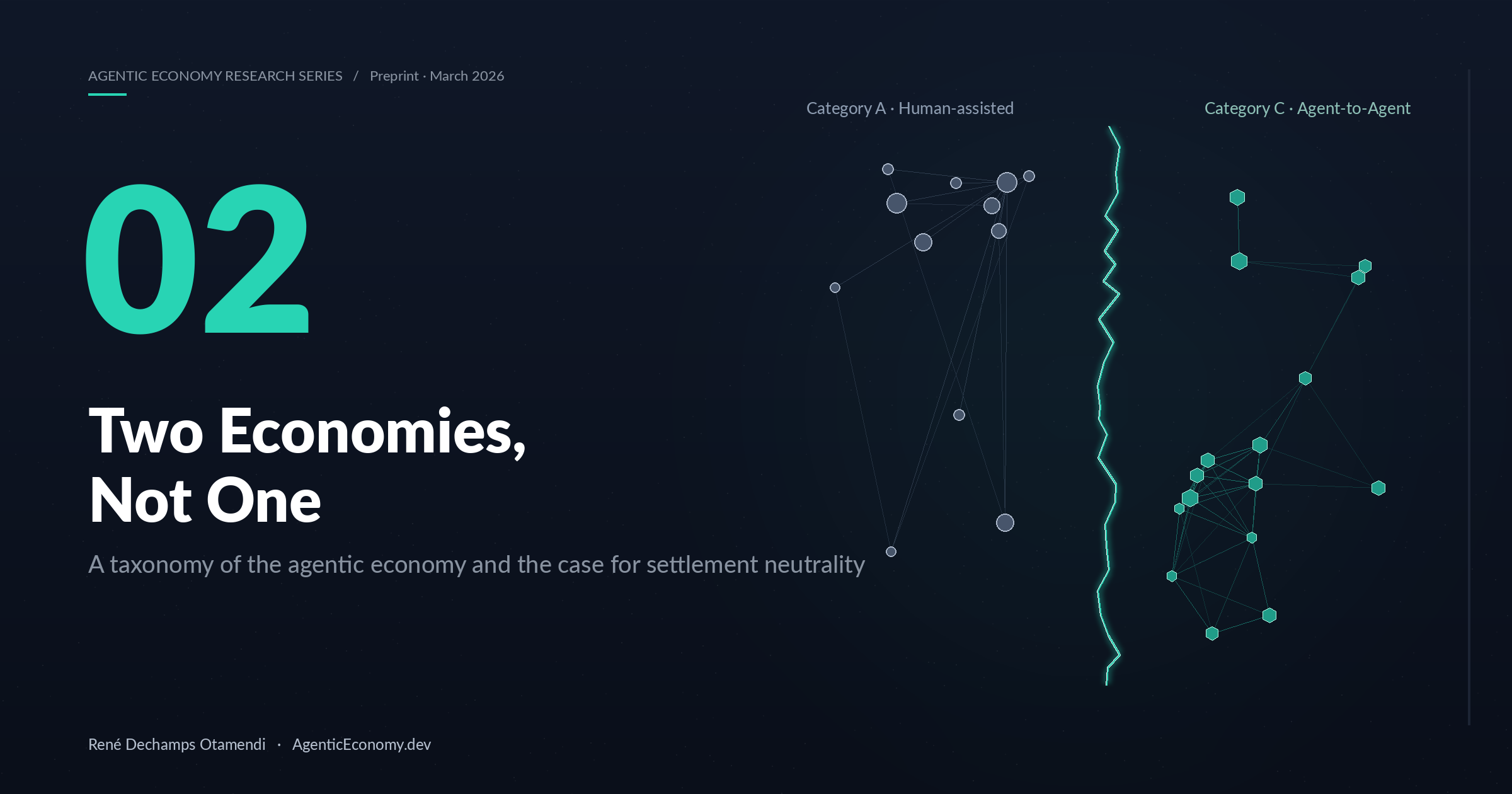
Popular discourse conflates two structurally different economies under the single label "agentic." The first — human-assisted agentic commerce — treats the agent as a tool operating on a human's behalf, with the human ultimately bearing legal and financial consequences. The second — autonomous agent-to-agent commerce — treats the agent as an economic principal, with cryptographic identity, independent stake, and settlement rails that do not route through any human custodian.
This paper introduces a three-category taxonomy (A — human-assisted; B — delegated with human-in-the-loop; C — fully autonomous agent-to-agent) and argues that the infrastructure appropriate to Category C is architecturally distinct from that of A and B. Specifically, we make the case that Category C commerce requires settlement neutrality — settlement rails that are not owned, priced, or gated by any single platform — and that collapsing all three categories into a single platform stack will replicate the winner-take-most dynamics of Web 2.0 in machine-speed commerce.
Video Summary & Audio Companion
The Three-Category Taxonomy
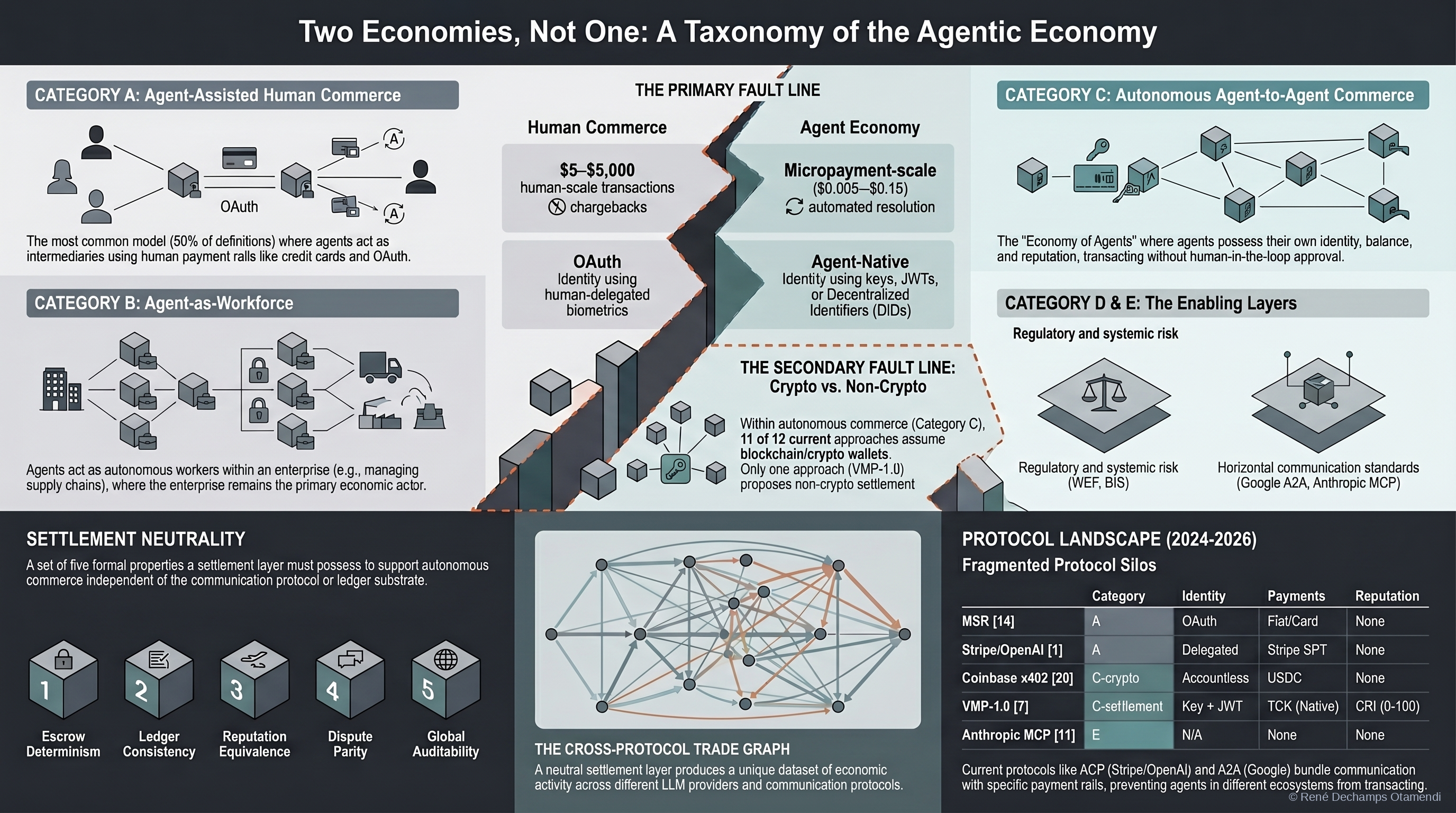
Key Findings
- "Agentic" is not a monolith: three categories (A/B/C) with materially different identity, stake, and settlement requirements.
- Category C — fully autonomous agent-to-agent — cannot be served by platform-owned settlement without reproducing Web 2.0 rent extraction.
- Settlement neutrality is not an ideology but an architectural requirement: it is the only structure under which Category C scales competitively.
- Conflating A/B/C leads to infrastructure decisions that optimize for A (human-in-the-loop) and fail silently for C (machine-speed, adversarial, single-shot).
Methodology
The paper surveys 51 published definitions of the agentic economy from the period January 2021 — March 2026. Definitions were drawn from peer-reviewed papers, protocol specifications, industry analyst reports, VC theses, central-bank working papers, and standards-body drafts. Each definition was coded along eight dimensions: definition type (descriptive, prescriptive, normative, operational, taxonomic), scope, temporal horizon, settlement assumption, actor model, trust model, infrastructure layer, and regulatory stance.
Coding was performed manually by the author with a single-coder reliability check on a randomly drawn 15 % sample re-coded one month after the initial pass. Inter-temporal agreement exceeded 92 % on every dimension. The codings, the underlying excerpts, and the bibliographic references are published as a single JSON corpus (definitions-corpus.json) under CC BY-SA 4.0 for replication.
From the coded dimensions, the paper derives six categories — A (agent-assisted human commerce), B (agent as workforce), C1 (autonomous agent-to-agent commerce, crypto-native), C2 (autonomous agent-to-agent commerce, settlement-neutral), D (macroeconomic framings), E (protocol specifications) — and two structural fault lines that cut across them: settlement assumption (fiat vs. crypto vs. neutral) and actor model (human-in-loop vs. autonomous).
The case for settlement neutrality is built constructively: the paper specifies the abstract requirements a settlement layer must satisfy to support both A and C interactions concurrently, and shows that satisfying those requirements does not require either side of the crypto/fiat fault line to be picked. Settlement neutrality is a feasibility result, not a value judgement.
Why this matters in practice
For operators choosing a stack today, the taxonomy clarifies a distinction the discourse routinely conflates. Most live deployments labelled “agentic commerce” are Category A: an agent shops for a human using human payment rails. Building infrastructure for Category C — agents transacting autonomously with each other — is a different problem with different protocols, identity assumptions, and dispute models. Conflating them produces specifications that are simultaneously over-engineered for A and under-engineered for C.
For investors, the two fault lines are the more useful signal than the six categories. Bets on the crypto-native side of the settlement fault line price the assumption that on-chain settlement will dominate; bets on the fiat side price the opposite. Settlement-neutral bets price the optionality of either outcome. Knowing which fault-line position a thesis assumes is a clearer due-diligence question than which “agentic economy” vertical it targets.
For standards bodies, settlement neutrality is the architecturally simplest path forward. A neutral escrow specification can be built in parallel to ACP, AP2, MCP, and x402, and converged on by all of them. The paper specifies what such a layer must guarantee — deterministic dispute resolution, parity across transports, and bounded latency variance — without binding it to any single payment rail.
Frequently asked questions
Why 63 definitions, not 51?
Earlier versions of the paper (Mar 2026) catalogued 51 definitions. The corpus has since grown to 63. The paper’s structural findings — the six categories, the two fault lines — are unchanged. A v2 of the paper is in preparation to reflect the corpus growth.
What counts as a “definition”?
A statement that proposes what the agentic economy is, written by a named author or institution, published in a venue with editorial control (journal, conference, official corporate channel, standards body). Tweets, opinion pieces in non-edited media, and personal blog posts without institutional backing are excluded.
Is the corpus complete?
It is a snapshot, not a closed set. New definitions are added as they are published. The canonical live version is at /agentic-economy-definitions; the frozen reference is the Zenodo release.
What is “settlement neutrality” in one sentence?
A settlement layer is neutral if it can clear transactions for both Category A (human-paid) and Category C (agent-paid) commerce without requiring either side of the fiat/crypto fault line to be selected at the protocol level.
How does this paper relate to Paper 4 (Fifty-One Maps)?
Paper 2 builds the taxonomy; Paper 4 uses the taxonomy to perform a diagnostic analysis on definitional divergence. Paper 4 is the diagnostic counterpart to this paper’s constructive proposal.
Cite this paper
@article{dechamps2026taxonomy,
  author  = {Dechamps Otamendi, Ren\'e},
  title   = {Two Economies, Not One: A Taxonomy of the Agentic Economy and the Case for Settlement Neutrality},
  year    = {2026},
  month   = {March},
  note    = {Preprint},
  doi     = {10.5281/zenodo.20039387},
  url     = {https://doi.org/10.5281/zenodo.20039387},
  orcid   = {0009-0007-1033-6519}
}